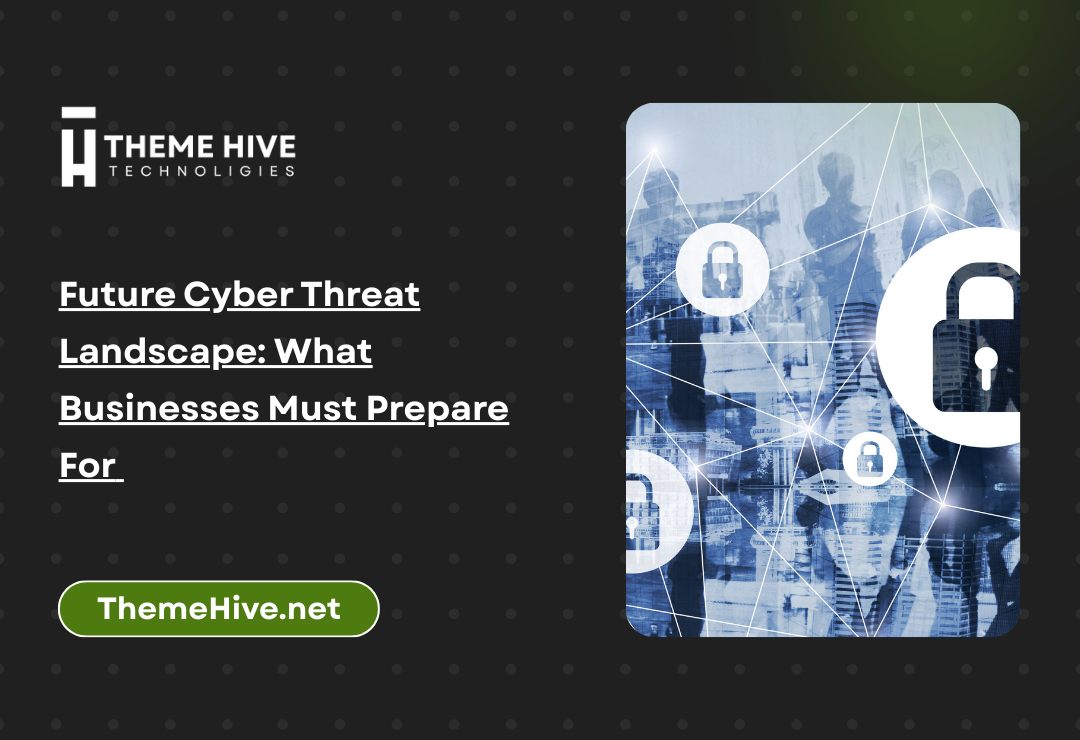
Cyber Threat Landscape: Ultimate Guide Businesses Must Know 2026
The evolving attack landscape is not a distant warning. Businesses that are not preparing today are already behind the sophisticated threat actors who are actively working against them.
01 The Cyber Threat Landscape Defined
The cyber threat landscape represents the full collection of attack methods, malicious actors, and exploitable vulnerabilities that businesses face in 2026. Understanding this evolving security environment is no longer optional for organizations of any size. The digital attack surface has expanded across cloud infrastructure, remote workforces, connected devices, and third-party software ecosystems simultaneously, creating more entry points for attackers than any previous era of computing.
Cyber Threat Landscape: Ultimate Guide 2026AI Attacks · Ransomware · Supply Chain · Quantum Risks Figure 1: The cyber threat landscape in 2026 spans AI-powered phishing, ransomware as a service, supply chain exploits, and emerging quantum decryption threats.
What makes today’s security environment significantly more dangerous than the one businesses navigated five years ago is the automation and accessibility of sophisticated attacks. Criminal organizations now operate like technology companies, offering attack tools as subscription services to affiliates with minimal technical knowledge. The result is an exponential growth in the volume and precision of attacks targeting organizations across every sector.
According to IBM’s Cost of a Data Breach Report 2024, the average cost of a breach reached an all-time high, with organizations in regulated industries averaging over $10 million per incident. The combination of direct financial damage, regulatory penalty, reputational harm, and operational disruption makes cybersecurity investment one of the highest-return decisions any business can make in 2026.
At ThemeHive Technologies, we build digital infrastructure with security embedded from the first architectural decision. Every business we work with faces the same fundamental challenge: how to operate and grow digitally while defending against an attack environment that is becoming more powerful every quarter.
02 AI-Powered Attacks in the Modern Threat Environment
Artificial intelligence has become the most transformative force reshaping today’s security threat environment. For decades, attackers were constrained by the time and expertise required to craft convincing campaigns. Advanced AI tools have removed those constraints entirely, enabling the generation of highly personalized attack content at a scale and speed no human operator could match.
AI-Generated Phishing Campaigns
Traditional phishing messages were detectable by grammar errors, generic greetings, and implausible scenarios. That detection advantage has largely disappeared. Modern AI-generated phishing campaigns draw on scraped public data from LinkedIn, company websites, and social media to craft messages that reference real colleagues, active projects, and genuine organizational context. Security researchers report that detection rates for conventional email security tools against AI-generated phishing have dropped below 40 percent in controlled testing environments.
Businesses must treat AI-generated phishing not as a cyber threat they will eventually face but as one they are already receiving. Security awareness training must be updated to reflect this reality, using simulated AI-crafted campaigns to educate employees on what modern deception looks like.
Deepfake Social Engineering
Voice and video deepfakes have entered business environments as serious financial risks. In 2024, a finance employee at a multinational company was deceived by a deepfake video call impersonating the company’s CFO, resulting in a $25 million unauthorized transfer. As deepfake generation quality improves and costs fall, this attack method will become significantly more common across organizations of all sizes. Verification protocols for high-value financial instructions are now an essential business control.
Adversarial AI Defeating Security Tools
The evolving attack landscape includes a sophisticated class of techniques specifically designed to defeat AI-based security systems. Adversarial machine learning allows attackers to craft malware that evades AI detection models, generate network activity that mimics legitimate behavior, and systematically probe security tools to map their detection gaps. Defensive AI and offensive AI are now advancing in parallel, creating an arms race that security teams must actively track.
Threat Assessment
AI-powered attacks in the current security environment do not require nation-state resources to execute. Off-the-shelf AI tools combined with widely available attack frameworks have placed sophisticated, personalized campaigns within reach of criminal actors with modest budgets and limited technical expertise.
03 Next-Generation Ransomware Threatening Businesses
Ransomware has evolved from a blunt tool that encrypted files into a sophisticated multi-stage extortion operation. Understanding this evolution is essential for every business preparing its defenses against the modern security threat environment. What began as opportunistic attacks against individuals has matured into an organized criminal industry generating billions of dollars annually.
Modern ransomware operates through a Ransomware as a Service model. Criminal organizations develop and maintain ransomware platforms that affiliates license in exchange for a percentage of collected ransoms. This business model has lowered the barrier to entry dramatically, enabling thousands of operators with limited technical knowledge to run targeted campaigns against businesses of every size. The cyber threat from ransomware is no longer concentrated among sophisticated nation-state actors. It is distributed across a vast criminal ecosystem.
Double and Triple Extortion Tactics
Modern ransomware attacks combine file encryption with the threat of publicly releasing stolen data, a technique called double extortion. Triple extortion adds direct pressure on a business’s customers, suppliers, and partners. This evolution means that even organizations with flawless backup and recovery processes remain exposed to reputational and regulatory damage if stolen data is released. Paying the ransom does not guarantee data deletion, and refusing does not eliminate the threat of publication.
Ransomware has transformed from a nuisance into a genuine existential risk for mid-market businesses that lack mature incident response and data recovery capabilities.Cybersecurity and Infrastructure Security Agency, 2025
04 Supply Chain Vulnerabilities in the Attack Landscape
Supply chain attacks represent one of the most dangerous dimensions of the modern security environment because they exploit the trust between organizations and their software vendors, technology partners, and service providers. Rather than attacking a target organization directly, threat actors compromise a trusted third party and use that access to reach hundreds or thousands of downstream targets simultaneously.
The SolarWinds breach introduced the world to the scale of supply chain compromise. A single corrupted software update reached 18,000 organizations including multiple government agencies. Since then, this attack model has been refined and repeated with increasing frequency, targeting development tools, cloud providers, managed security service providers, and open source packages that millions of applications depend on daily.
Cyber Threat Defense: Supply Chain Attack VectorsSoftware Vendors · Cloud Providers · Open Source · MSPs Figure 2: Understanding cyber threat vectors in the supply chain is essential for businesses building defenses in the modern digital security environment.
Business Risk
Every piece of software your business uses is a potential entry point for supply chain compromise. Software composition analysis, vendor security assessments, and formal third-party risk management programs are essential controls for organizations operating in the current security environment.
Section Five
05 Quantum Computing and Emerging Encryption Risks
Quantum computing represents a longer-horizon but strategically critical dimension of the evolving security threat environment. The encryption algorithms protecting virtually all sensitive data in transit today, including TLS, RSA, and elliptic curve cryptography, rely on mathematical problems that classical computers cannot solve within practical timeframes. Quantum computers can solve these problems exponentially faster, rendering current encryption standards obsolete at scale.
Nation-state threat actors are already employing a strategy known as harvest now, decrypt later. They collect encrypted data today, store it, and plan to decrypt it once quantum computers reach sufficient capability. For businesses handling data with long-term confidentiality requirements including healthcare records, financial data, intellectual property, and legal communications, this dimension of the evolving attack landscape demands post-quantum cryptography planning beginning now.
The National Institute of Standards and Technology finalized the first post-quantum cryptography standards in 2024. Businesses should begin auditing their cryptographic dependencies and building migration roadmaps rather than waiting until quantum computing capability becomes commercially available.
06Industries Most Exposed in the Current Security Environment
While the modern attack landscape poses risks to every organization, certain industries face disproportionate exposure due to the sensitivity of their data, the criticality of their infrastructure, and the relative maturity of their security investments. Every business should understand where its own industry sits in this risk picture.
Critical Exposure Healthcare
Patient records command premium prices on criminal markets. Healthcare organizations face ransomware attacks that threaten patient safety by disabling clinical systems during active care delivery.
Critical Exposure Financial Services
Banks, insurers, and fintech companies are primary targets for both direct financial theft and destructive attacks designed to undermine confidence in critical financial infrastructure.
High Exposure Manufacturing
Operational technology systems are increasingly connected to corporate networks, creating new attack surfaces that can halt production lines and compromise industrial safety controls.
High Exposure Government and Public Sector
Nation-state actors target government agencies for intelligence gathering, infrastructure disruption, and influence operations extending far beyond financial motivation.
Growing Exposure Education
Universities and schools hold research data, personal records of minors, and financial information. They represent attractive targets with security budgets that rarely match the value of their data assets.
Growing Exposure Small and Mid-Sized Business
SMBs are the fastest-growing target segment. Attackers exploit the gap between substantial SMB digital footprints and the limited security investments that most smaller organizations maintain.
07 How Businesses Must Defend Against the Cyber Threat
Preparing for the evolving cyber threat environment requires moving beyond the reactive, perimeter-based security model that most organizations still rely on. Defending effectively in 2026 demands a proactive, intelligence-driven posture that assumes breach, limits lateral movement, and accelerates detection and response time from months to minutes.
08 Building a Resilient Security Framework for 2026
Defending against the evolving attack landscape requires a structured security framework rather than a disconnected collection of point solutions. The following practices define what a mature, future-ready security posture looks like for businesses operating in the current digital environment.
- Implement zero trust network access so that no user or system receives implicit trust regardless of their position inside or outside the network perimeter
- Deploy AI-powered security information and event management tools that detect behavioral anomalies representative of advanced persistent threat activity in real time
- Establish immutable and air-gapped backup systems that cannot be encrypted or deleted by ransomware actors who have gained access to your primary environment
- Conduct continuous employee security awareness training that includes simulated AI-generated phishing campaigns reflecting the sophistication of modern attack methods
- Implement a formal third-party risk management program assessing the security posture of every vendor and service provider with access to your systems or data assets
- Develop and regularly test an incident response plan covering every major attack category that businesses face in the current security environment
- Begin a cryptographic inventory audit to identify every system dependent on encryption algorithms vulnerable to future quantum computing capability
- Adopt software composition analysis tooling to detect vulnerable and malicious components in every application your business builds or operates in production
Security Leadership Guidance
Organizations that align their security investments with the specific attack methods most relevant to their industry, data profile, and operational model consistently achieve better outcomes than those applying generic frameworks without contextual prioritization. Know your threat model before building your controls.
09 What Lies Ahead in the Evolving Security Landscape
The security threat environment will be defined by three converging forces that businesses must understand and actively prepare for. Each of these forces amplifies the others, creating a digital risk environment more complex than any organization has previously navigated.
Autonomous Attack Systems
The next generation of security threats will increasingly feature fully autonomous attack systems that identify targets, exploit vulnerabilities, establish persistence, and exfiltrate data without human direction once deployed. These systems will scan the entire internet continuously, identifying unpatched systems and exposed credentials in seconds. Organizations relying on slow, manual patch management will find themselves compromised before a human attacker would even have noticed the opportunity in the traditional sense.
Geopolitical Dimensions of Cyber Conflict
The modern security environment is inseparable from geopolitical tensions between major powers. Nation-state threat actors are pre-positioning access within critical infrastructure in adversary countries, ready to activate disruptive attacks during periods of political conflict. Private businesses operating critical infrastructure or holding strategically important data will find themselves caught in this dimension of the attack landscape regardless of their own political neutrality.
Regulatory Expansion and Liability
Governments worldwide are responding to the evolving online security environment with rapidly expanding cybersecurity regulation. The EU Cyber Resilience Act, updated SEC cybersecurity disclosure rules, and sector-specific mandates are imposing new legal and financial liabilities on businesses that fail to maintain adequate defenses. In the near future, inadequate security posture will expose businesses not only to attacks but to significant regulatory penalty and civil liability.
The team at ThemeHive Technologies helps businesses build digital infrastructure designed for security from the very first architectural decision. Explore our full range of services or reach out directly to discuss how your organization can build genuine resilience against the threats that are coming.
The businesses that invest in understanding the cyber threat environment now, build layered defenses with genuine depth, and develop real incident response capability will be the ones that survive and grow when the sophisticated attacks currently in development inevitably arrive at their doorstep.
10 Frequently Asked Questions
What is the biggest security threat for small businesses in 2026?
Ransomware delivered through AI-generated phishing emails represents the most immediate and damaging attack method for small and mid-sized businesses. SMBs are targeted precisely because they hold valuable data while carrying lighter security investments than enterprises. Immutable backups, employee training, and multi-factor authentication are the three highest-priority controls for smaller organizations facing today’s threat environment.
How is AI changing the cyber threat environment for businesses?
AI is reshaping the security threat environment by removing the time and expertise constraints that previously limited sophisticated attacks. Attackers now generate personalized phishing at mass scale, create convincing deepfakes for social engineering, and build malware specifically designed to evade AI-based detection systems. The attack landscape powered by AI is faster, more targeted, and harder to detect than anything organizations have previously encountered.
Should businesses worry about quantum computing security risks now?
Yes, particularly organizations handling data requiring long-term confidentiality. The harvest now, decrypt later strategy means nation-state actors are collecting encrypted data today with plans to decrypt it as quantum capability matures. Businesses should begin cryptographic audits and post-quantum migration planning in 2026 rather than waiting until the threat becomes operationally immediate.
What is zero trust and why does the modern security environment require it?
Zero trust is a security model that grants no implicit trust to any user, device, or system regardless of their network location. Every access request is continuously verified. The current attack landscape requires zero trust because traditional perimeter-based security assumes threats come from outside, an assumption that supply chain attacks, insider threats, and stolen credentials completely invalidate in modern environments.
How much should a business invest in cybersecurity in 2026?
Industry benchmarks suggest allocating 10 to 15 percent of total IT budget to cybersecurity as a defensible baseline. However, investment levels should be driven by a formal threat model assessing the specific attack methods most relevant to the organization’s industry, data assets, and operational dependencies rather than by arbitrary percentage targets applied without context.