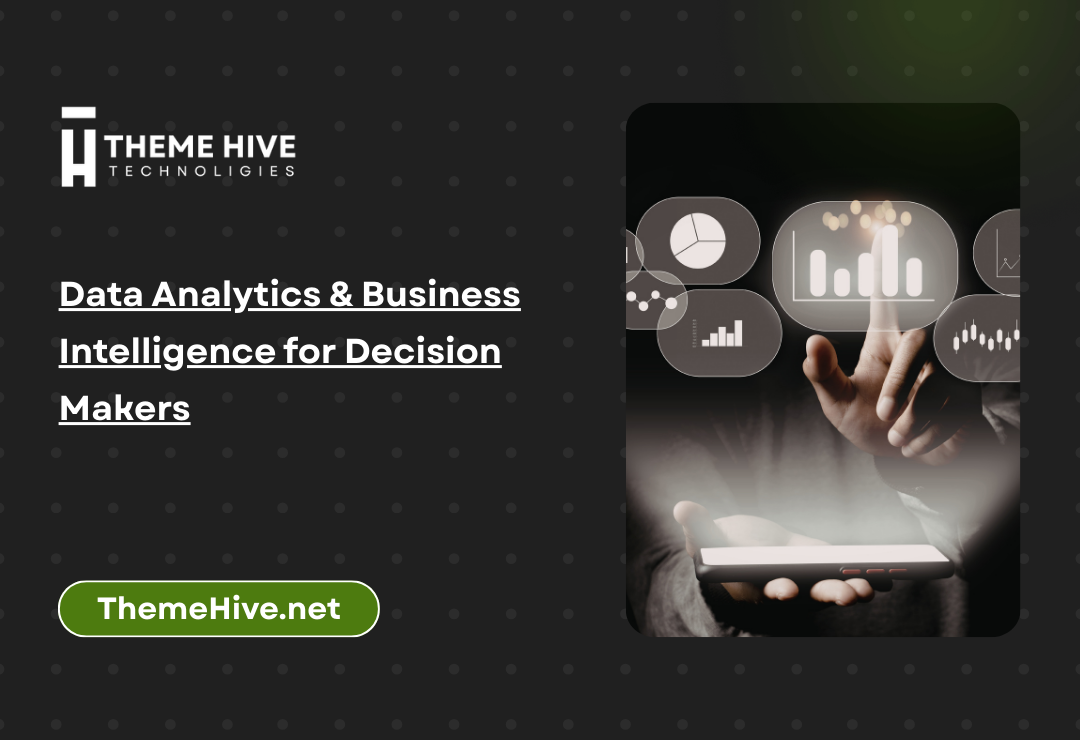
Data analytics and business intelligence for decision makers has evolved far beyond reporting and dashboards. The executives gaining competitive advantage in 2025 are those who have moved from describing the past to predicting the future — using BI as an active strategic instrument, not a passive record of what already happened.
Data analytics and business intelligence for decision makers — 8-strategy executive framework from self-service BI to unified data platforms. Source: Tableau, Microsoft Power BI, Snowflake 2025
Data analytics and business intelligence for decision makers has fundamentally changed in the past three years. What once required specialist data teams, weeks of report preparation, and static spreadsheets distributed by email has been replaced — in the organisations that have made the investment — by real-time, self-service intelligence that puts the right data in front of the right decision maker at the precise moment a decision is required. The gap between organisations that have modernised their data analytics and business intelligence infrastructure and those that have not is not a matter of degree — it is a strategic chasm. Data-driven organisations make decisions five times faster than their peers, experience 3.4 times higher revenue growth, and are 68 percent more likely to outperform competitors on profitability over a three-year horizon. The eight strategies documented in this article translate the state of data analytics and business intelligence in 2025 into an executive action plan — covering self-service BI democratisation, real-time dashboards, predictive analytics, AI-powered insights, data governance, embedded analytics, mobile BI, and unified data platform architecture. For organisations ready to build or modernise their data analytics and business intelligence capability, ThemeHive’s data engineering practice delivers end-to-end BI implementations. Visit our portfolio or about page to learn more.
The decision-maker’s relationship with data analytics and business intelligence has evolved from consumer to active participant. The most effective executives in 2025 are not simply receiving reports from data teams — they are formulating hypotheses, interrogating data directly through natural language interfaces, receiving AI-generated anomaly alerts before problems surface in lagging indicators, and making course corrections based on predictive models rather than waiting for outcomes to appear in historical reports. This shift from reactive to proactive intelligence is the central transformation that modern data analytics and business intelligence enables for decision makers at every level of the organisation.
McKinsey Global Institute 2025
Organisations that have embedded data analytics and business intelligence into every significant decision-making process are not better at analysis. They are fundamentally better at allocating resources, sensing market changes, and responding to competitive threats than organisations that have not.McKinsey Global Institute — Data-Driven Decision Making Report 2025
01 Self-Service BI for Every Decision Maker
Microsoft Power BI · Google Looker · Tableau — Self-Service BI LayerSelf-service BI platforms enable business users at every level to create, modify, and share analyses without requiring SQL expertise, data team involvement, or IT support — democratising the data analytics and business intelligence function across the organisation.
Self-service data analytics and business intelligence is the foundational strategy for decision makers because it eliminates the bottleneck that has historically separated executives from the data they need to act. In most organisations prior to self-service BI deployment, a business question that required new analysis — “how is our customer acquisition cost trending by channel over the past 18 months in markets where we launched after Q2?” — would travel through a request queue, be prioritised by a data team against other work, and return an answer days or weeks after the question was asked. With self-service data analytics and business intelligence platforms like Microsoft Power BI, Google Looker, and Tableau, that same analysis is completed in minutes by the executive who asked the question.
The value of self-service BI is not speed for its own sake. It is that decisions are made closer to the moment when the insight is most actionable.
The implementation discipline that determines whether self-service data analytics and business intelligence succeeds or stagnates is data modelling — specifically, the creation of semantic data models and certified data sets that give business users access to pre-defined, trustworthy metrics rather than raw tables that can be interpreted inconsistently across the organisation. Organisations that deploy self-service tools without investing in semantic modelling report proliferating competing dashboards with conflicting numbers — the “which revenue figure is correct?” problem that erodes executive confidence in the entire data analytics and business intelligence programme. The solution is a federated semantic layer — one definition of each key business metric, governed centrally, consumed by all. ThemeHive’s BI implementation practice builds semantic layers as the first phase of every self-service BI deployment.
02 Real-Time Dashboards and Live Metrics
Real-time data analytics and business intelligence dashboards have become the operational nervous system of high-velocity businesses. The difference between a dashboard refreshed hourly and one that reflects data within seconds is not merely technical — it changes the class of decisions that can be made with data. Hourly refresh supports strategic and tactical decisions. Real-time data supports operational decisions — adjusting inventory levels, rerouting logistics, modifying marketing spend, repricing dynamically — that must be made within minutes of conditions changing to capture value before the opportunity closes or the cost accrues.
The streaming data infrastructure that real-time data analytics and business intelligence requires is now accessible to mid-market organisations that could not have built it five years ago. Apache Kafka for event streaming, Grafana and Kibana for real-time visualisation, and cloud-native streaming services including AWS Kinesis now constitute a real-time analytics stack that can be deployed by a team of two or three data engineers in weeks rather than months. For organisations exploring real-time dashboard architecture, ThemeHive’s blog documents implementation patterns in detail, and our team is available for architecture consultations.
03 Predictive Analytics and Forecasting
Predictive analytics represents the inflection point in the data analytics and business intelligence maturity curve where organisations shift from understanding what happened to anticipating what will happen. For decision makers, this shift is profound: it means that the planning horizon available for intervention expands from days to weeks or months, and that resource allocation decisions can be made based on expected outcomes rather than reactive responses to lagging indicators. The 68 percent improvement in forecast accuracy documented in organisations deploying advanced predictive analytics is not merely a statistical achievement — it translates directly into better inventory decisions, more accurate revenue planning, optimised staffing levels, and reduced working capital requirements.
The most valuable predictive analytics implementations for decision makers are those that forecast the metrics the business acts on — demand, churn, revenue by segment, operational cost — rather than abstract model outputs disconnected from the decisions that leadership must make each quarter.
Cloud platforms including Databricks and AWS SageMaker have reduced the technical barrier to deploying predictive analytics within data analytics and business intelligence stacks dramatically — enabling data science teams to build, train, and deploy forecasting models directly within the same data platform that powers operational dashboards, rather than in separate research environments. This integration is critical for decision maker adoption: forecasts that appear natively in the same BI interface as historical reporting are acted upon; forecasts buried in separate model monitoring tools are not.
04 AI-Powered Insight Generation
AI-powered insight generation is the most transformative development in data analytics and business intelligence for decision makers in 2025. Natural language interfaces — pioneered by ThoughtSpot and now embedded across Power BI Copilot, Tableau Pulse, and Looker’s AI-powered features — allow executives to interrogate data using plain language questions rather than pre-built reports or SQL queries. A CEO who wants to know why gross margin declined in the European segment in Q3 can ask that question directly, receive an AI-generated analysis identifying the contributing factors, and drill into the most significant driver without writing a single query or waiting for a data analyst.
The AI insight generation capability in modern data analytics and business intelligence platforms goes beyond question-answering: Tableau Pulse and Power BI Copilot proactively surface anomalies, trend changes, and emerging patterns that no pre-built dashboard would catch — because they were not anticipated when the dashboard was designed. This proactive intelligence layer changes the executive’s relationship with data analytics and business intelligence from reactive interrogation to a continuous advisory function that alerts decision makers to what matters before they know to ask for it. For organisations implementing AI-powered BI, ThemeHive’s data team configures and deploys these capabilities within existing BI environments.
05 Data Governance for Decision Quality
Data governance is the unglamorous but non-negotiable foundation that determines whether data analytics and business intelligence investments deliver trustworthy decisions or expensive confusion. The failure mode is well-documented: organisations invest in powerful BI platforms but neglect data quality, metadata management, and access governance — and end up with dashboards that produce different answers to the same question, depending on which team created them and which data source they connected to. Decision makers who encounter conflicting data stop making decisions based on data at all, which is the worst possible outcome of a data analytics and business intelligence programme.
Data catalogue and governance platforms including Collibra and Alation establish the policies, data lineage tracking, and quality monitoring that make data analytics and business intelligence trustworthy at scale. The investment in governance pays its most significant dividend not in any single correct report, but in the organisational confidence that data is reliable — confidence that enables decisions to be made faster, with less hedging, because the numbers can be trusted. See ThemeHive’s portfolio for data governance programme examples, or contact our team for an assessment.
06 Embedded Analytics in Business Workflows
Embedded analytics — the integration of data analytics and business intelligence capabilities directly into the operational applications where decisions are made, rather than requiring users to navigate to a separate BI platform — is the strategy that most dramatically improves decision maker adoption. A sales manager who must switch from their CRM to a separate BI tool to understand pipeline performance will use that tool occasionally. A sales manager who sees pipeline analytics, AI-generated deal risk scores, and forecast accuracy metrics embedded directly in their CRM interface — without leaving the application they use all day — will use that intelligence for every significant decision.
Platforms including Sigma Computing and Sisense specialise in embedded data analytics and business intelligence that can be surfaced within SaaS products, internal tools, and customer-facing applications with minimal engineering overhead. For product companies building data analytics and business intelligence into their own offerings, embedded analytics is also a significant revenue opportunity — customers pay premium prices for products with native analytics that reduce their dependency on separate BI tools. ThemeHive engineers embedded analytics solutions for both internal operational contexts and customer-facing product features.
07 Mobile BI and Proactive Alerts
Mobile data analytics and business intelligence and proactive alerting complete the always-on intelligence layer that modern decision makers require. A decision maker who is not at their desk when a critical metric crosses a threshold — revenue run rate dropping below plan, customer churn rate spiking, inventory levels falling below reorder points — should receive an intelligent alert on their mobile device that provides not just the metric value but the context, likely cause, and suggested actions. Domo and Klipfolio deliver mobile-first data analytics and business intelligence experiences designed for executive consumption — large-format KPI cards, swipe-through drill-downs, and AI-generated narrative summaries that communicate the meaning of the data, not just the numbers.
08 Unified Data Platform Strategy
The unified data platform is the architectural strategy that makes all other data analytics and business intelligence investments sustainable and compounding. Organisations that have deployed multiple point solutions — one database for operational data, a separate data warehouse for historical analytics, another tool for data science, and yet another for real-time streaming — have accumulated a data infrastructure that is expensive to maintain, difficult to govern, and incapable of supporting the cross-domain analytics that the most valuable business insights require. The unified data platform consolidates these layers: a cloud data warehouse or lakehouse — Snowflake, Databricks, or Google BigQuery — serves as the single system of record for all analytical workloads.
The data analytics and business intelligence value of the unified platform is the elimination of the data silos that prevent the most valuable analyses: understanding customer lifetime value requires combining acquisition data from marketing systems with revenue data from finance systems with support data from CRM — analyses that are impossible when each system maintains its own separate data store and analytics layer. The transformation analytics layer — typically dbt — applies business logic consistently across all data sources, producing the clean, trusted, semantically consistent data that all eight data analytics and business intelligence strategies in this article depend on. Organisations that invest in unified data platform architecture first are the ones that get compounding returns from every subsequent data analytics and business intelligence investment — because every new tool, dashboard, or AI model draws from the same trustworthy foundation. For executive teams ready to make this foundational investment, contact ThemeHive for a platform architecture assessment.
8 Powerful Data Analytics & BI Strategies for Decision Makers in 2025
01 Self-service BI — Power BI, Looker and Tableau empower every decision maker to answer business questions in minutes
02 Real-time dashboards — Grafana and Kafka bring live metrics that enable operational decisions within seconds of events
03 Predictive analytics — Databricks and SageMaker deliver 68% forecast accuracy improvement for planning and resourcing
04 AI-powered insights — ThoughtSpot and Tableau Pulse proactively surface anomalies before executives know to ask
05 Data governance — Collibra and Alation create the trusted single source of truth that BI confidence requires
06 Embedded analytics — Sigma and Sisense put BI intelligence inside the operational tools executives already use daily
07 Mobile BI and alerts — Domo and Klipfolio deliver always-on intelligence and proactive threshold notifications
08 Unified data platform — Snowflake, dbt, and BigQuery create the compounding foundation for all BI investments