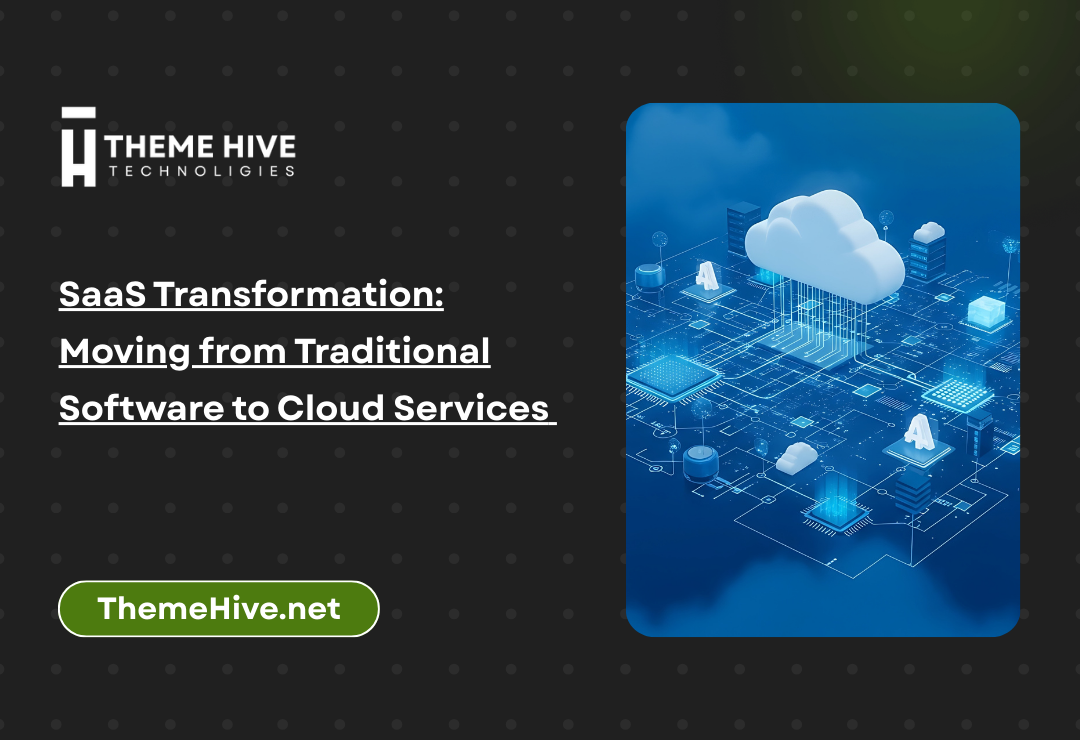
Businesses across every industry are abandoning legacy software in favour of cloud-based SaaS platforms. This guide explains what SaaS transformation truly means, why it matters more than ever, and how your organisation can make the shift with confidence.
What Is SaaS Transformation?
SaaS transformation is the strategic process of replacing on-premise, traditionally installed software with cloud-based, subscription-driven Software-as-a-Service platforms. It is not simply a technical exercise. It represents a fundamental shift in how organisations think about acquiring, deploying, maintaining, and scaling their technology infrastructure.
For decades, businesses operated on a model where software arrived on physical media or download links, was installed on local machines or servers, and was maintained entirely by internal IT departments. That model made sense in a slower world. Today, it is increasingly a liability. SaaS transformation replaces that static, high-maintenance model with one that is dynamic, always updated, and accessible from anywhere on earth.
The scale of this shift is extraordinary. According to Gartner, global SaaS spending exceeded 197 billion US dollars in 2024 and continues to grow at an annual rate above 18 percent. This is not a passing trend. It is a structural reorganisation of how the world builds and consumes software. At ThemeHive Technologies, we work closely with organisations navigating this transition, and the demand for expert cloud migration guidance has never been higher.
Understanding SaaS transformation begins with recognising that its value is not only technical. It reshapes procurement, financial planning, employee workflows, and competitive positioning simultaneously. Organisations that approach it as a purely IT project consistently underestimate both its complexity and its opportunity.
The Growing Problems with Traditional Software
Traditional software served businesses faithfully for several decades. Enterprise resource planning systems, customer relationship tools, accounting platforms, and productivity suites built on desktop and server architectures powered entire industries. But the environment those tools were designed for no longer exists.
The first and most visible problem is cost. Purchasing traditional software requires significant capital expenditure upfront. Licensing fees, server hardware, installation projects, and annual maintenance contracts accumulate into budgets that consume resources without generating growth. A mid-sized company deploying a traditional ERP system could easily spend half a million dollars before a single employee logs in.
The second problem is speed. Legacy systems update slowly, if at all. Security patches, feature improvements, and compatibility fixes require IT teams to manually intervene across every device. In an era where cybersecurity threats emerge daily and competitor products evolve monthly, that pace is simply untenable.
The Scalability Ceiling
Perhaps the most damaging limitation of traditional software is its inability to scale elegantly. When a business grows, adding new users to a legacy system requires purchasing additional licences, provisioning new hardware, and running extended deployment projects. What should be a celebration of company growth becomes an operational burden that slows momentum at exactly the wrong moment.
A 2023 IDC study found that companies relying on legacy software spend up to 80 percent of their IT budget on maintenance alone, leaving only 20 percent available for innovation, growth, and competitive improvement. SaaS transformation reverses that equation entirely.
Remote and hybrid work delivered a final, definitive test that traditional software largely failed. When organisations needed their entire workforce to operate from home instantly, on-premise systems bound to local networks became immediate obstacles. Cloud-based SaaS platforms became, almost overnight, the only viable foundation for business continuity.
The Core Advantages of SaaS Transformation
SaaS transformation delivers measurable, compounding benefits that directly improve financial performance, operational agility, and employee experience. Understanding these advantages helps organisations build the business case for migration with clarity and confidence.
Predictable, Reduced Costs
SaaS platforms operate on subscription models. Organisations pay a predictable monthly or annual fee that covers the software, hosting, updates, and support in a single line item. There is no server hardware to purchase, no upgrade projects to budget for, and no surprise maintenance bills. Research consistently shows that SaaS delivers a 30 to 50 percent reduction in total cost of ownership over a five-year period compared to equivalent on-premise deployments.
Continuous Updates and Security
With SaaS, the vendor manages all updates, security patches, and feature releases. When Salesforce adds a new capability or Microsoft addresses a vulnerability in Microsoft 365, every customer receives the improvement automatically. Organisations wake up each morning to a more capable, more secure platform without any action from their IT team.
True Location Independence
Cloud-based SaaS tools are accessible from any device with an internet connection. This was a competitive advantage before 2020. After the global acceleration of remote work, it became a non-negotiable requirement. Teams using platforms like Google Workspace, Slack, or HubSpot maintained full productivity regardless of physical location, while competitors tied to on-premise tools faced significant disruption.
Elastic Scalability
SaaS platforms scale with a business instantly and proportionally. Adding a hundred new users to a cloud-based CRM takes minutes and a billing adjustment. Removing licences during a contraction is equally straightforward. This elasticity converts what was previously a capital-intensive infrastructure challenge into a simple operational decision.
- IT maintenance burden reduced by up to 60 percent across typical enterprise deployments
- Deployment timelines measured in days rather than months
- Built-in disaster recovery, redundancy, and automated data backup at enterprise grade
- Seamless integrations with other platforms through open APIs and native connectors
- Real-time collaboration features that eliminate version control issues permanently
- Compliance tools embedded within leading SaaS platforms for regulated industries
Our cloud transformation services at ThemeHive Technologies are built around these exact advantages, helping organisations move to SaaS in a way that maximises every benefit from day one of migration.
Traditional Software vs. SaaS: A Direct Comparison
Understanding the structural differences between these two models is essential for any organisation planning a SaaS transformation. The contrast across key operational dimensions is substantial.
The SaaS Migration Journey: Six Proven Phases
Successful SaaS transformation is a structured process, not a single event. Organisations that attempt to migrate everything simultaneously almost always encounter significant disruption. A phased approach reduces risk, builds internal confidence, and delivers visible value at every stage of the journey.
Audit and Inventory
Begin by cataloguing every software tool the organisation currently uses. Identify which systems are mission-critical, which are redundant, and which already have mature SaaS equivalents. This audit becomes the foundation of the entire transformation roadmap.
Identify Quick Wins First
Start with lower-risk, high-impact migrations. Moving email and productivity tools to Google Workspace or Microsoft 365 is a proven early win that delivers immediate value and builds organisational confidence in the SaaS model before tackling more complex systems.
Evaluate and Select Vendors
Not every SaaS platform is equal. Assess vendors on security certifications such as SOC 2 and ISO 27001, uptime commitments, data residency compliance, integration capabilities, and long-term product roadmap alignment with your business needs. Never select a vendor based on price alone.
Pilot Testing and Training
Run a controlled pilot with a focused team before company-wide rollout. Use this phase to surface integration issues, develop training programmes, and identify change management challenges. User adoption is consistently the single greatest obstacle in any SaaS transformation project.
Full Migration and Decommission
Execute the complete migration with a clear cutover plan and defined rollback procedures. Once the SaaS platform is stable, decommission the legacy system promptly. Allowing both systems to operate simultaneously creates shadow IT that delays adoption and dilutes the value of the migration.
Optimise and Expand
Post-migration, review licence utilisation regularly, eliminate unused seats, and explore integration opportunities between platforms. Use analytics tools built into your SaaS stack to generate actionable business insights that were never available from legacy systems.
If your organisation is considering this journey, our project portfolio at ThemeHive Technologies demonstrates how we have guided businesses through each of these phases with measurable outcomes.
Key Challenges in SaaS Transformation
SaaS transformation creates extraordinary opportunities, but it is not without genuine challenges. Recognising these obstacles clearly is the foundation of any successful migration strategy.
Security and Compliance Requirements
Entrusting sensitive business data to a third-party cloud environment raises legitimate security questions. Organisations operating in regulated industries including healthcare, financial services, and legal must verify that their chosen SaaS vendors comply with all relevant frameworks such as GDPR, HIPAA, and SOC 2 Type II. Due diligence before contract signature is not optional. It is the single most important step in the vendor selection process.
Leading resources such as Google Cloud Security documentation and AWS Compliance resources provide detailed frameworks for evaluating cloud vendor security postures across industry-specific requirements.
Change Management and User Adoption
Technology selection is the straightforward part of SaaS transformation. Human behaviour is far more complex. Employees who have used the same systems for years frequently resist change, regardless of how superior the replacement may be. Without active executive sponsorship, structured training programmes, and a genuine culture of continuous improvement, even the most carefully selected SaaS platforms will underperform.
“SaaS transformation is 30 percent technology and 70 percent people, process, and culture. Organisations that forget this ratio will consistently struggle to realise the value they invested in.”McKinsey Digital Transformation Report, 2024
Vendor Lock-in Risk
Moving to SaaS creates a new form of dependency. If critical business processes are built deeply into a single vendor’s ecosystem, migrating away later becomes expensive and operationally complex. Mitigate this risk by prioritising vendors with open, well-documented APIs, ensuring full data portability is contractually guaranteed, and avoiding deep platform customisation that cannot be transferred to alternative solutions.
Integration Complexity
Connecting new SaaS platforms with existing systems, whether on-premise or cloud-based, can become surprisingly intricate without proper planning. A well-designed integration architecture using middleware platforms or native iPaaS connectors is essential to prevent data silos from emerging and eroding the efficiency gains that motivated the migration in the first place.
Our team at ThemeHive Technologies is available to assess your current software landscape and provide a clear integration roadmap tailored to your specific environment.
SaaS Transformation Across Key Industries
SaaS transformation does not manifest identically across every sector. The priorities, compliance requirements, and pace of adoption vary significantly by industry, and understanding these distinctions helps organisations calibrate their own transformation strategy against relevant benchmarks.
Healthcare
Cloud-based Electronic Health Record platforms, telemedicine tools, and patient engagement systems have fundamentally changed how healthcare organisations operate. SaaS transformation in healthcare enables real-time data access across care teams, seamless telehealth integration, and AI-powered diagnostic support, all while maintaining HIPAA compliance through vendor-managed security frameworks and business associate agreements.
Financial Services
Banks, insurance providers, and fintech companies leverage SaaS transformation for customer relationship management, fraud detection, regulatory reporting, and risk analytics. Purpose-built platforms designed for financial services compliance have addressed the regulatory concerns that previously kept this sector anchored to on-premise infrastructure longer than most industries.
Retail and Commerce
Commerce-focused SaaS platforms have completely disrupted traditional retail software. Inventory management, order fulfilment, customer loyalty programmes, and omnichannel marketing analytics are now unified within cloud platforms that update in real time across every channel simultaneously. Businesses that have completed SaaS transformation in retail consistently report faster product launches and significantly improved customer experience metrics.
Professional Services
Agencies, consultancies, and technology firms have among the highest SaaS adoption rates of any sector. Project management, client communication, billing, and resource planning tools built on cloud architectures have enabled professional services firms to scale revenue without proportional increases in operational overhead. This efficiency multiplier is one of the most compelling arguments for SaaS transformation in any service-oriented business.
Key Insight
Research from Flexera’s 2024 State of the Cloud Report found that 94 percent of enterprises now use cloud services in some form, and organisations with mature SaaS transformation strategies report an average of 23 percent lower IT operating costs compared to peers still running predominantly on-premise infrastructure.
The Future of SaaS: What Comes Next
SaaS transformation is not a destination. It is an ongoing evolution shaped by technological advancement and shifting business requirements. Three forces are defining the next phase of this evolution: artificial intelligence integration, vertical market specialisation, and composable software architectures.
AI-Native SaaS Platforms
The embedding of artificial intelligence directly into SaaS platforms is accelerating from novelty to necessity. Tools are now automating complex workflows, surfacing predictive insights from operational data, and personalising user experiences at a scale that was previously impossible. Within two years, AI capabilities embedded natively into the platform will be a baseline expectation for any enterprise-grade SaaS solution rather than a premium differentiator.
Vertical SaaS Dominance
Horizontal platforms designed to serve every business equally are increasingly giving ground to vertical SaaS solutions built specifically for single industries. Platforms built exclusively for construction, life sciences, restaurant management, or legal services are demonstrating that deep industry focus creates stronger user adoption, faster time-to-value, and significantly higher retention than generic alternatives. This specialisation trend is accelerating rapidly.
Composable Architecture
The next evolution of enterprise software is composable, meaning organisations will assemble their technology stacks from best-of-breed SaaS components connected through APIs and integration layers, rather than committing to monolithic vendor suites. This approach demands strong integration strategy and governance but delivers unparalleled flexibility, enabling businesses to replace any single component without disrupting the surrounding ecosystem.
Staying current with these developments is part of what we do at ThemeHive Technologies. Our team continuously evaluates emerging SaaS platforms and integration patterns to ensure our clients are building on architecture that will serve their needs today and remain competitive for the years ahead.
SaaS transformation is ultimately about organisational agility. Businesses that make this transition gain the speed, scalability, and data intelligence to compete in a market where the pace of change continues to accelerate. Those who delay face compounding disadvantages, not only in their technology, but in their ability to attract talent, serve customers, and sustain growth.
The cloud is not the future of enterprise software. For the vast majority of industries, it is already the present. The relevant question is no longer whether your organisation should pursue SaaS transformation. It is how strategically and how well you execute it.